With ISS’s latest policy updates loosening the proxy advisor’s preference for at least 50% of LTI in PSUs as long as time-based equity meets its long-term parameters, we already knew that some companies have been considering making a change. FW Cook reviewed forward-looking disclosures in 2026 proxy statements to see if any companies have already committed to taking the plunge. They found at least six companies that have already disclosed a transition, as summarized below.
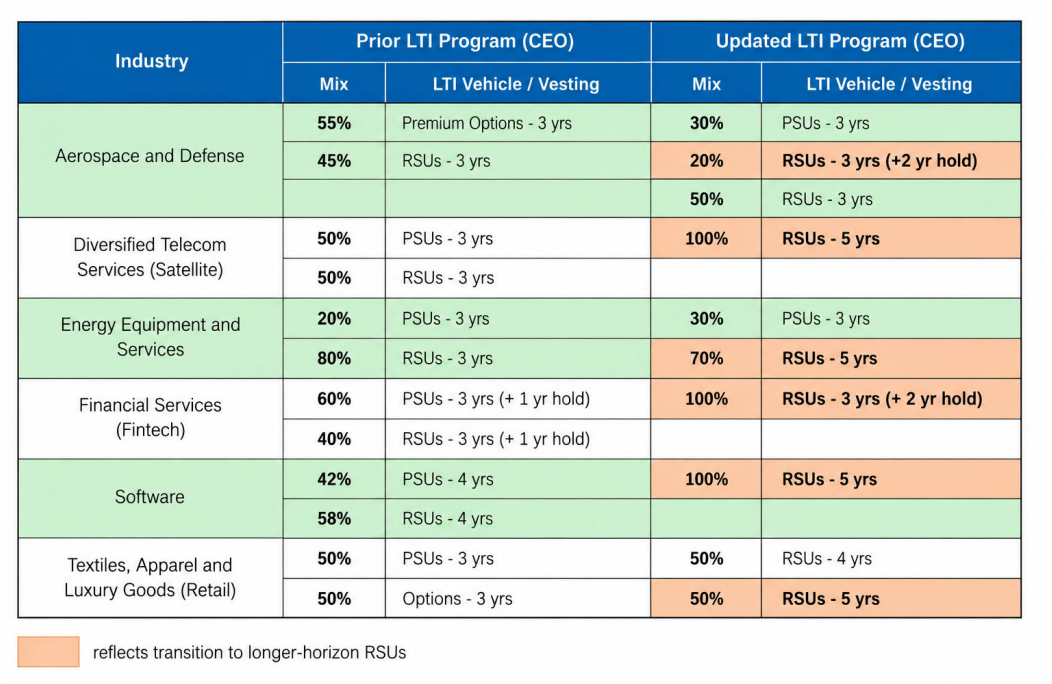
They highlighted a few considerations and takeaways from these early movers:
– Many of them had one thing in common: they are in cyclical, seasonal or volatile businesses.
– Companies shouldn’t think of the decision as a binary one. Reducing PSU weighting and introducing longer vesting RSUs might be the right first move for some companies.
– The shift can create vesting gaps, and companies should model the transition for each executive to understand the impact.
– Meredith Ervine
It’s possible that pay-versus-performance disclosure requirements as we currently know them are going to be short-lived, but the ship hasn’t sailed yet – and in the meantime, people are using the data. In this article, Stephen O’Byrne of Shareholder Value Advisors makes the argument that PVP information is much more useful than SCT disclosure that focuses on grant date fair value – and shows that conventional wisdom about pay programs may be misguided. Here’s an excerpt (also see this HLS blog):
The conventional wisdom is that companies can achieve the three basic objectives of executive pay – providing strong incentives to increase shareholder value, retaining key talent and limiting shareholder cost – if they have a high percent of pay at risk with target pay set at the peer group median. The conventional wisdom accepts a low correlation of target (and grant date) pay with relative TSR but argues that post-grant date changes in the value of unvested equity provide a strong incentive to increase shareholder value.
For 70 years, proxy statements only reported grant date pay and there was no way to test the truth of the conventional wisdom. The new PvP disclosure provides, for the first time, the data to test the conventional wisdom and it shows that the conventional wisdom doesn’t work well for many companies.
For more than half, relative TSR explains less than 50% of the variation in relative mark to market pay. A third of companies have very weak incentives – a 1% increase in relative shareholder
wealth increases relative mark to mark pay by less than 0.2%. The analysis we do with the PvP data, i.e., plotting relative pay against relative TSR to quantify five pay dimensions, provides a guide path to better pay design. It provides a clear goal, showing that there is a simple pay plan with annual grants of performance shares that provides a perfect correlation of relative pay and relative performance with pay leverage of 1.0 and a zero pay premium at peer group average performance. It also provides a way to monitor progress toward the goal: benchmarking pay dimensions – alignment, incentive strength, relative pay risk and performance adjusted cost – to measure progress in improving the company’s pay plan.
Stephen walks through a couple of case studies in the article to show how PVP can be used to measure alignment across the dimensions he identified. He also outlines how it could be used to measure the impact of CEO pay and stock ownership on future shareholder returns. I don’t know that every company would have the resources to perform these analyses, but some are already doing so anyway for existing models – and Stephen suggests that pivoting to the PVP data would ultimately simplify compensation-setting and voting. First, though, you have to overcome the mental block of “new maths to math.”
The article suggests ways that investors could use PVP in say-on-pay voting guidelines, and says that the existing ISS models that many companies have designed around have resulted in misaligned pay in some cases. Meredith blogged earlier this year about how some investor models may already be evolving…
– Liz Dunshee