I’m thrilled to be joined by so many of you in Orlando and virtually this week! We’re kicking things off today with our “Proxy Disclosure Conference” and we’ll follow that up tomorrow with our “23rd Annual Executive Compensation Conference.” The agendas for our conferences include 13 substantive panels over 2 days – and we’ll get started in style with Dave Lynn’s interview of Christina Thomas, Deputy Director of the SEC’s Division of Corporation Finance and Chief Advisor on Disclosure, Policy, and Rulemaking.
We’re very excited to see everyone in Orlando, but if you can’t be here in person, you can still register to attend today’s program and tomorrow’s “23rd Annual Executive Compensation Disclosure Conference” online or by calling us at 800-737-1271. Our conferences are bundled together into a single two-day event for registration and pricing, so your purchase will cover both events and you’ll get access to the archived programs for a year afterwards.
– How to Attend Online: Our conferences are hosted online through the RingCentral Events platform. When you register for the conferences, you’ll receive a registration confirmation email that will contain your personalized “Magic Link.” Just click on that link to be instantly directed to the event. The Magic Link acts as an “access pass” into the event. It is unique to you and cannot be shared with others. It bypasses the need for registered users to sign into RingCentral Events and brings you directly into your RingCentral Events account and into the event.
Once in the event, click the “Stage” button from the menu on the left of the webpage. In order to view the session currently playing on stage, you will need to press the play button on the video. If you’re having issues accessing the RingCentral Events platform, review this guide and contact your IT department. For audio/video issues, there are separate guides for Windows and for Mac. If you still need help, email info@ccrcorp.com.
– Access to Archives & On-Demand CLE: Your registration includes access to the conference archives, which will be available until October 12, 2027 – but you’ll need your confirmation email to access them so be sure to retain it! One big reason to make sure you do that is that if you can’t attend the conferences live, you may earn on-demand CLE credit by viewing the archives. See these “CLE FAQs for Archived Conference Sessions (ON DEMAND)” for more information.
– Thanks to Our Sponsors! A huge “thank you” to our sponsors who have helped make these events possible. Our founding sponsor for this year’s conferences is Goodwin, our PDEC lounge sponsor is Greenshoe.ai, our managing partner sponsor is Cooley, our associate sponsors are Ashurst Perkins Coie, Ballard Spahr, King & Spalding, Latham & Watkins, Morrison Foerster, Sidley, Troutman Pepper Locke, and Wilson Sonsini – and a special shoutout to our rise and shine breakfast sponsors Cleary and Dragon GC.
We are extremely grateful for the support of these fine law firms and businesses and invite you to consider joining them as a sponsor of next year’s conferences.
Make sure to say hi if you’re here in person – and if the mood strikes, post a selfie or two on LinkedIn!
Yesterday, ISS announced the results of its latest annual global Benchmark policy survey, which asked participants several compensation-related questions. For example, the survey asked for input on how to signal significant concerns about executive pay when no say-on-pay vote is on the ballot, given that more companies may be exempt from holding this vote if the SEC’s “Filer Status” rule changes are adopted as proposed. The press release summarizes the answers to that question as follows:
Fifty percent of investor respondents said that where pay concerns and a say-on-pay vote is not on the ballot, they would support in the first year opposing the election of the chair of the compensation committee, and a further 41 percent of investor respondents supported opposing all incumbent compensation committee members. Among non-investor respondents, 54 percent of non-investor respondents said opposition of compensation committee members would not be appropriate under such circumstances.
The survey also addressed several other U.S. compensation topics. Here’s a brief summary of the input ISS received on those matters:
As a follow-up, the survey asked what level of support for compensation committee members should be considered a low vote that triggers ISS’s responsiveness policy. (Currently, there’s a 50% director election threshold and a 70% say-on-pay threshold.) Most investor respondents (67%) favored the 70% threshold applying for purposes of assessing whether the responsiveness policy has been triggered. Only 26% of non-investor respondents supported the 70% threshold. 46% of non-investor respondents supported the 50% threshold.
Investor and non-investor respondents differed on whether financial services companies’ discretionary bonus programs should receive special, sector-specific treatment rather than being treated generally as a concern in the pay-for-performance evaluation, with 85% of non-investors saying financial services discretion-based bonus programs should not be viewed as a concern, while 71% of investor respondents said they should continue to be treated as concerning. However, more than 80% of both groups agreed that disclosures — like pre-set pay opportunities, performance category or factor weightings plus explanations regarding payout determinations — could mitigate concerns.
Finally, the survey also asked whether and when the risk of competitive harm constitutes a compelling rationale for not disclosing forward-looking LTI performance targets, and specifically whether it’s less compelling for relative than for absolute metric goals. For investors, the most common response (50%) was that this could be a reasonable rationale but should be assessed on a case-by-case basis. Non-investor respondents most commonly (49%) thought the risk of competitive harm is a reasonable rationale for non-disclosure by any company. Some respondents (21% of investors and 31% of non-investors) thought the risk of competitive harm may be a compelling rationale if the company commits to retrospective disclosure. That same number of investor respondents (21%) thought competitive harm is not a reasonable rationale in most or all cases. Investors largely (79%) considered the rationale more compelling for absolute versus relative performance metrics, while non-investors were evently split.
See Liz’s blog on TheCorporateCounsel.net for the results of the governance-related survey questions.
This month last year, Glass Lewis announced that it will be moving away from “singularly-focused research and vote recommendations based on its house policy.” Last month, the proxy advisor announced that it has now opened a comment period on the four perspectives that will underpin its research beginning in September 2027 and is soliciting feedback from both institutional investor and corporate stakeholder groups. Pay Governance recently released a viewpoint regarding how this shift is likely to impact say-on-pay votes.
The four perspectives share a common compensation foundation. All perspectives maintain core expectations around reasonable pay levels, pay-for-performance alignment, disclosure quality, severance practices, incentive design, non-employee director pay programs, and other key governance topics.
The major differences among the models lie in how the perspectives may weigh performance, sustainability, and stakeholder outcomes. Business Fundamentals could treat top-quartile relative TSR as an explicit mitigating factor, allowing greater tolerance for higher pay or certain design features. Sustainability Focused may instead expect material sustainability considerations in performance measurement and assess whether pay outcomes align with the broader stakeholder experience. Thus, a company’s Say on Pay proposal may draw different recommendations—particularly when pay is high, relative TSR is strong, sustainability metrics are absent, or stakeholder and executive outcomes diverge [. . .]
The proposed Glass Lewis pivot on advisory reports changes the lens through which programs are viewed, but not the fundamentals. Compensation committees should continue to design pay to align with business strategy, performance, and long-term value creation, supported by rigorous governance and an investor-informed rationale. The best-positioned companies will not attempt to tailor their programs to each Glass Lewis perspective; rather, they will understand their shareholders and explain why their programs are right for their business.
It reiterates that this announcement is part of a broader trend where “investor policies—and not one proxy advisor standard—may increasingly drive voting decisions.” It also notes that pay disclosure may be fundamentally transformed by proposed and expected SEC rulemaking that could reduce and streamline required disclosures—and even make many more companies eligible for scaled disclosure and other accommodations, like omitting a say-on-pay proposal. This could raise the stakes for some companies (if investors voice their perspectives through “withhold” votes on compensation committee members, for example) and increase the need to provide more context and address more perspectives in your disclosures, even as disclosure requirements become less prescriptive.
As Liz shared on TheCorporateCounsel.net yesterday, Walt Disney World celebrated its 55th anniversary last week and marked the occasion by looking back at what it has been through since 1971 and how much has changed along the way. Through all of it, the magic has endured! That feels on point for those of us working in corporate governance and executive compensation as well. So the timing is right to gather at our 2026 Proxy Disclosure & 23rd Annual Executive Compensation Conferences next Monday and Tuesday, October 12th and 13th (less than one week away!), in Orlando and virtually, to discuss perennial issues plus the many regulatory and market developments companies are navigating right now. Getting together with a group of people with a shared passion for corporate governance, quality disclosure and pay-for-performance always feels magical to me!
Here’s a look at some of the hot topics our experienced speakers will be addressing. You’ll walk away with a better understanding of the practical impact these developments may have on companies, disclosures and boards – and how all the moving pieces fit together.
On October 12th, our 2026 Proxy Disclosure Conference will focus on (you guessed it) proxy disclosures – starting with an interview with Corp Fin Deputy Director Christina Thomas. Among other topics, we’ll discuss the fate of shareholder proposals, the current shareholder activism environment, common mishaps (and how to avoid and resolve them), tokenization of securities and other market developments, SEC proposals on registered offering reform and filer status, shareholder engagement and voting, and advising boards during times of uncertainty.
On October 13th, our 23rd Annual Executive Compensation Conference turns to (yep!) executive pay, including potential changes to the SEC’s compensation disclosure rules, the potential expansion of scaled disclosure, equity design (including long-vested RSUs), special awards, executive and director pay trends, and perks and executive security. We will close the conference with the popular panel “Navigating ISS & Glass Lewis” featuring a practical conversation with representatives from both proxy advisors on disclosures and practices that will help (or hurt) your cause on say-on-pay, compensation committee elections and equity incentive plan approvals, moderated by Davis Polk’s Ning Chiu.
For those attending in person, the magic actually starts a little early! We’ll have a welcome reception Sunday, October 11th, from 4:30–6:00 p.m. in the Orange Foyer. And the networking opportunities continue on the evening of the 12th at the NASPP opening celebration immediately after Monday’s programming.
As always, the two days are bundled together, and you can join us in person at the Hilton Orlando or virtually. And in addition to live and on-demand access to all of the CCRcorp sessions, Conference attendees get exclusive access to our Course Materials – which are up on the conference platform and app now and include unique & practical bullet points on the topics our speakers will be covering. The Course Materials and on-demand replays are invaluable resources to refer back to as proxy season approaches!
Act Now: The Conferences begin next Monday, October 12th. With 14 sessions over 2 days, you’ll walk away with action items to help support director elections and say-on-pay, see around corners for changes to rules and market mechanics that affect companies, and avoid costly mistakes. You can still register. Sign up online, email info@ccrcorp.com or call our team at 800-737-1271 today.
Lastly, if you have registered, remember that your unique access link and attendance instructions will be emailed to you from no-reply@events.ringcentral.com. Here’s more detail on what to watch for.
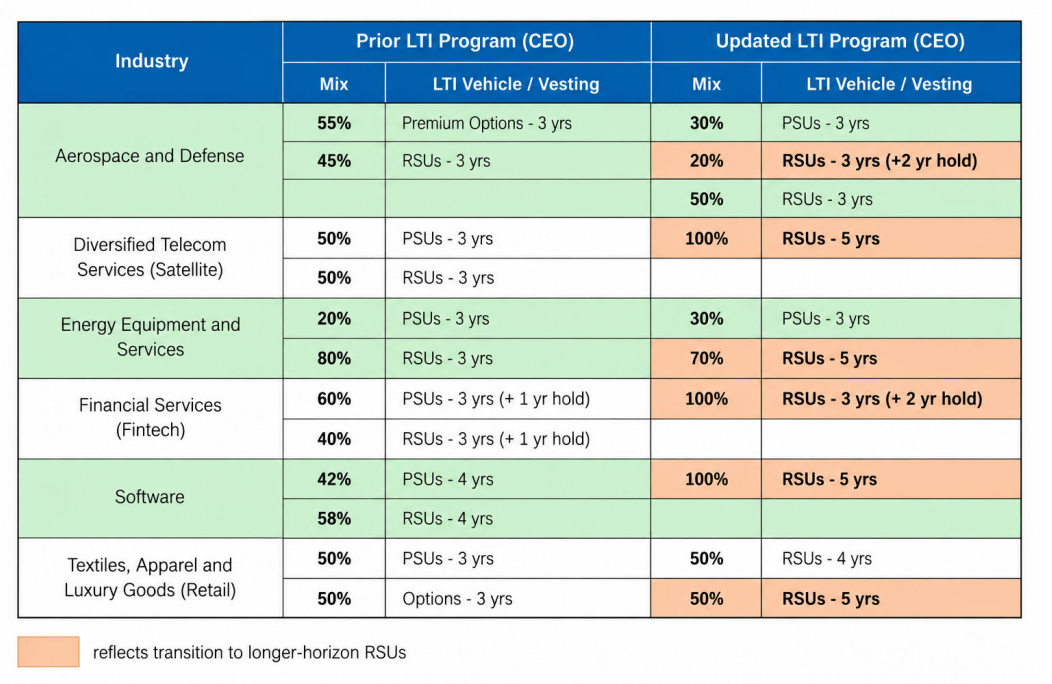
With ISS’s latest policy updates loosening the proxy advisor’s preference for at least 50% of LTI in PSUs as long as time-based equity meets its long-term parameters, we already knew that some companies have been considering making a change. FW Cook reviewed forward-looking disclosures in 2026 proxy statements to see if any companies have already committed to taking the plunge. They found at least six companies that have already disclosed a transition, as summarized below.
They highlighted a few considerations and takeaways from these early movers:
– Many of them had one thing in common: they are in cyclical, seasonal or volatile businesses.
– Companies shouldn’t think of the decision as a binary one. Reducing PSU weighting and introducing longer vesting RSUs might be the right first move for some companies.
– The shift can create vesting gaps, and companies should model the transition for each executive to understand the impact.
It’s possible that pay-versus-performance disclosure requirements as we currently know them are going to be short-lived, but the ship hasn’t sailed yet – and in the meantime, people are using the data. In this article, Stephen O’Byrne of Shareholder Value Advisors makes the argument that PVP information is much more useful than SCT disclosure that focuses on grant date fair value – and shows that conventional wisdom about pay programs may be misguided. Here’s an excerpt (also see this HLS blog):
The conventional wisdom is that companies can achieve the three basic objectives of executive pay – providing strong incentives to increase shareholder value, retaining key talent and limiting shareholder cost – if they have a high percent of pay at risk with target pay set at the peer group median. The conventional wisdom accepts a low correlation of target (and grant date) pay with relative TSR but argues that post-grant date changes in the value of unvested equity provide a strong incentive to increase shareholder value.
For 70 years, proxy statements only reported grant date pay and there was no way to test the truth of the conventional wisdom. The new PvP disclosure provides, for the first time, the data to test the conventional wisdom and it shows that the conventional wisdom doesn’t work well for many companies.
For more than half, relative TSR explains less than 50% of the variation in relative mark to market pay. A third of companies have very weak incentives – a 1% increase in relative shareholder
wealth increases relative mark to mark pay by less than 0.2%. The analysis we do with the PvP data, i.e., plotting relative pay against relative TSR to quantify five pay dimensions, provides a guide path to better pay design. It provides a clear goal, showing that there is a simple pay plan with annual grants of performance shares that provides a perfect correlation of relative pay and relative performance with pay leverage of 1.0 and a zero pay premium at peer group average performance. It also provides a way to monitor progress toward the goal: benchmarking pay dimensions – alignment, incentive strength, relative pay risk and performance adjusted cost – to measure progress in improving the company’s pay plan.
Stephen walks through a couple of case studies in the article to show how PVP can be used to measure alignment across the dimensions he identified. He also outlines how it could be used to measure the impact of CEO pay and stock ownership on future shareholder returns. I don’t know that every company would have the resources to perform these analyses, but some are already doing so anyway for existing models – and Stephen suggests that pivoting to the PVP data would ultimately simplify compensation-setting and voting. First, though, you have to overcome the mental block of “new maths to math.”
The article suggests ways that investors could use PVP in say-on-pay voting guidelines, and says that the existing ISS models that many companies have designed around have resulted in misaligned pay in some cases. Meredith blogged earlier this year about how some investor models may already be evolving…
With underwater options in the news, companies that award this form of equity may want to consider what to do if the awards were granted at a market peak and/or the company’s stock price has been declining. This Semler Brossy newsletter points out that this issue can affect the broader executive team – not just the CEO. It suggests questions for boards:
1. Where in the organization are options best aligned with the compensation philosophy?
2. Even if options are underwater now, what is the upside potential under various rebound scenarios, and how do we best communicate that to recipients?
3. If your options are meaningfully underwater, is an exchange program worth exploring, or does the signal it sends outweigh the benefit? Related resource: What to do about deep underwater stock options.
4. If you were to move away from options, what vehicle would better capture performance without abandoning program rigor?
The newsletter cites to a recent study that found roughly a third of stock options granted since 2023 are now underwater – especially in retail and healthcare. The Semler Brossy team also notes that only about 45% of S&P 500 companies are granting options these days – but they haven’t disappeared. With such a big potential upside, they are still a vehicle at companies large and small. See our “Stock Options” Practice Area for more resources.
Share counting on Form S-8 is not always a straightforward exercise. In fact, we have an entire checklist explaining how to do it. But sometimes, even with the best of effort, mistakes happen. What happens then?
Yesterday, the SEC posted this administrative proceeding order about a company that discovered it had sold shares pursuant to an ESPP in excess of the number registered on its Form S-8 registration statements. My stomach always sinks when I read about over-issues – record-keeping may be out of the securities lawyer’s hands, but any clean-up will be in their court.
I was relieved to see that in this case, the company handled it well and the story had a (relatively) happy ending – with a cease-and-desist order and no civil penalty. According to the SEC, here’s what led to the over-issue:
– During the Relevant Period, the company did not have policies addressing the need to keep an accurate count of shares sold under the ESPP. While the company had legacy procedures for operating the ESPP and for preparing its annual proxy statement (which, as described in the order, included a disclosure of shares remaining for sale under the ESPP), these procedures, implemented prior to the Relevant Period, were not adequate to ensure that the company kept accurate records of shares sold under the ESPP.
– The company hired a third party to administer the ESPP – that party committed, among other things, to “maintain share lot history” and provide regular reports to the company. There were monthly letters about the purchases and sales, but the company didn’t use those letters to track the shares remaining available for issuance.
– During the Relevant Period, once a year, consistent with its legacy procedures, in connection with the preparation of its proxy statement, the company asked the service provider to indicate how many shares it had sold under the ESPP in the most recent calendar year. The company subtracted this figure from the “shares remaining” figure on the latest proxy statement, and input the result into the new proxy statement. The company did not otherwise track the number of shares remaining for sale under the ESPP during the Relevant Period. At some point, this figure became inaccurate.
– In connection with preparing a new S-8, the company asked the service provider to provide a complete record of all shares sold under the ESPP since inception. That spreadsheet indicated that the company had sold shares in excess of the aggregate number of shares it had registered on the Form S-8 registration statements.
Here’s what the company did next:
– Upon discovery of the violation, the company promptly suspended the ESPP and conducted an investigation.
– The company then self-reported the violation to the Commission and voluntarily initiated a rescission offer to provide compensation to all affected current and former employees for all shares sold in excess of the ESPP registration, even including as eligible securities for which actions would otherwise have been barred under Section 12(a)(1) of the Securities Act.
– Following the self-report, the company also voluntarily produced relevant factual information and documentation to the Commission staff.
The order is a good case study on firming up controls. And while every enforcement proceeding is unique and YMMV depending on many circumstances, the company’s response also seems to provide a good roadmap for addressing an S-8 overissue.
At our upcoming “Proxy Disclosure & 23rd Annual Executive Compensation Conferences,” I’ll be moderating a “campfire” discussion of scary securities law stories – with Howard Dicker of Weil Gotshal, JT Ho of Cleary Gottlieb, and Allison Handy of Ashurst Perkins Coie. These seasoned practitioners will regale us with their own tales of over-issues and other mishaps they’ve seen – and give pointers on how to resolve them. Join this session in Orlando (or virtually) on October 12th at 11:30 a.m. ET – it will be sure to put you in the Halloween spirit! You can still register for the Conferences – online, by email to info@ccrcorp.com or by calling our team at 800-737-1271. Don’t wait – the Conferences are only two weeks away!
Just two short weeks away, and the anticipation is high! Our “Proxy Disclosure & 23rd Annual Executive Compensation Conferences” are happening in Orlando on Monday, October 12th and Tuesday, October 13th (and virtually, nationwide). If you haven’t already registered, there is still time to do so – but don’t delay! You will not want to miss our action-packed agenda full of practical tips on what you need to know and do in response to all of the SEC’s rulemaking and the current disclosure and corporate governance environment. Here are a few notes:
– Make sure to get in as soon as possible – the hotel is nearly full. Book your room here!
– After you’ve registered, check your email for a message from CCRcorp – via no-reply@events.ringcentral.com (our conference platform and app provider) – This email confirms your registration and contains your unique link to access the conference platform. Meredith shared more detail in this blog.
– Come say hi at our reception Sunday night, October 11th, and at the NASPP welcome reception on Monday night, October 12th. Get the details in this blog.
To register for the conferences, visit our online store, email info@ccrcorp.com or call our team at 800-737-1271 today.
BlackRock Investment Stewardship (BIS), which is responsible for stewardship activities related to BlackRock index funds, has published its Global Voting Spotlight for the period of July 1, 2025 to June 30, 2026. Here are the key executive compensation-related takeaways from the summary of its voting activity:
– BIS voted on 18,705 executive compensation (management and shareholder) proposals (approximately 12%).
– Concern about the alignment of executive compensation with shareholders’ long-term financial interests was the fourth most common reason BIS cited for not supporting director reelections (impacting 1,063 proposals categorized as director elections at 596 companies).
– In the U.S., pay concerns were driven by “large outside-of-program awards without a strong strategic rationale, limited linkages between pay outcomes and long-term financial performance, or insufficient explanation of how compensation program design supported corporate strategy.”
– BIS supported approximately 84% (15,780 out of 18,705) of compensation-related management proposals overall and approximately 90% in the Americas.
– BIS’s support was “driven by many companies’ clear articulation of how their policies align with shareholders’ long-term financial interests, particularly around how short- and long-term incentive plans complement one another and are effective in rewarding executives who deliver long-term financial value.”